
What Families Should Do When a Senior Starts Missing Medications
A missed tablet can look like a small slip. A strip left untouched. A diabetes medicine taken after the meal instead of before it. A blood pressure pill skipped because “I felt fine today.” But when missed doses become a pattern, they can point to something bigger: confusion, side effects, low mood, cost pressure, poor eyesight, or a medicine routine that has become too complicated.
For older adults, medicines often sit at the centre of daily health. Missing them can affect blood pressure, blood sugar, pain control, sleep, mood, or heart rhythm. Some medicines are forgiving if one dose is late. Others, like blood thinners, insulin, seizure medicines, or certain heart tablets, need more caution.
Families do not need to panic. They do need to respond early, calmly, and with a plan.
This article is for general information only. It does not replace advice from a doctor, pharmacist, or other qualified healthcare professional.

Start with safety before solving the routine
The first question is not “Why did this happen?” It is “Could this missed dose cause harm right now?”
If a senior has missed one dose, do not automatically give a double dose. That can be risky. Different medicines have different rules. Some can be taken later the same day. Some should be skipped until the next scheduled time. Some need urgent advice.
Call the prescribing doctor, clinic, or pharmacist if the missed medicine is for:
Diabetes, especially insulin or tablets that can affect blood sugar
Blood thinning, such as anticoagulants
Heart rhythm or heart failure
Seizures
Parkinson’s disease
Severe pain
Mental health conditions
Steroids or medicines that should not be stopped suddenly
Seek urgent medical help if the senior has worrying symptoms such as chest pain, severe breathlessness, fainting, confusion, one-sided weakness, slurred speech, very low blood sugar signs, repeated vomiting, or a seizure.
For most situations, the practical first step is simple: write down what was missed, when it was likely missed, and whether any symptoms appeared. This gives the doctor or pharmacist something clear to work with.
Talk about it without blame
Many older adults feel embarrassed when they start missing medicines. Some fear losing independence. Others may worry that family members will treat them like a child. A harsh reaction can make the problem go underground.
A better opening sounds calm and specific:
“I noticed a few tablets are still in the strip from this week. Let’s check together so we can make the routine easier.”
Avoid starting with “You forgot again” or “Why are you not taking this seriously?” Even if the worry is real, blame rarely creates honesty.
The aim is to learn what is happening. The reason may be very practical:
The tablet looks similar to another one
The print on the strip is too small
The dose timing is confusing
The medicine causes dizziness, acidity, sleepiness, or frequent urination
The senior does not understand what the medicine is for
The refill ran out
The senior feels better and thinks the medicine is no longer needed
There are too many tablets in a day
The routine changed after travel, illness, or a hospital visit
Missing medicines is not always forgetfulness. Sometimes it is a signal the treatment plan needs to be reviewed.
Check the whole medicine list
A medicine routine can grow slowly. One doctor adds a tablet for blood pressure. Another adds calcium. A hospital discharge summary changes the timing. A neighbour recommends a supplement. Over time, the senior may have prescription medicines, over-the-counter tablets, Ayurvedic or herbal products, vitamins, creams, drops, and inhalers all mixed together.
Create one current medicine list. Do this with the actual packets in front of you, not from memory.
Include:
Medicine name
Strength, such as 500 mg or 5 mg
Dose
Time of day
Why it is taken
Doctor who prescribed it
Start date, if known
Any side effects noticed
Whether it is still being taken
Also include medicines taken only when needed, such as painkillers, acidity tablets, laxatives, sleeping tablets, cough syrups, or allergy medicines.
Once the list is ready, book a review with the doctor or pharmacist. Ask direct questions:
Are all these medicines still needed?
Can any timings be simplified?
Are any tablets duplicates?
Could side effects be making the senior avoid a medicine?
Are any medicines interacting with each other?
Can once-daily options be used where suitable?
Should any medicine be taken before food, after food, or at bedtime?
Do not stop long-term medicines without medical advice. But do ask whether the plan can be made simpler. A routine that fits real life is more likely to work.

Look for common causes of missed doses
When a senior starts missing medications, the cause is often a mix of memory, routine, and physical changes. Use the missed doses as clues.
What you notice | What it may suggest | What can help |
Tablets left in the morning section | The morning routine is too rushed or unclear | Link medicines with breakfast, tea, or brushing teeth |
Missed night tablets | The senior falls asleep early or forgets after dinner | Shift timing if the doctor agrees, or set an evening reminder |
Wrong tablets taken | Similar packaging or poor eyesight | Use large labels, separate boxes, or colour markers |
Refills often run out | No refill tracking system | Mark refill dates and keep a small buffer |
Senior refuses a specific tablet | Side effects, fear, or misunderstanding | Discuss with the doctor before changing it |
Doses missed after outings | Routine breaks on travel days | Keep a safe travel pouch with one day’s medicines |
Frequent confusion about timing | Too many doses across the day | Ask if the schedule can be simplified |
Also check for changes in eyesight, hearing, hand strength, swallowing, sleep, appetite, mood, and memory. Arthritis can make blister packs hard to open. Cataracts can make labels unreadable. Depression can reduce motivation. Mild cognitive impairment may first show up as trouble managing bills, appointments, cooking, or medicines.
A senior who was once very careful may not suddenly become careless. Their needs may have changed.
Build a simple medicine system
The best system is the one the senior will actually use. It should be visible, easy to understand, and not dependent on memory alone.
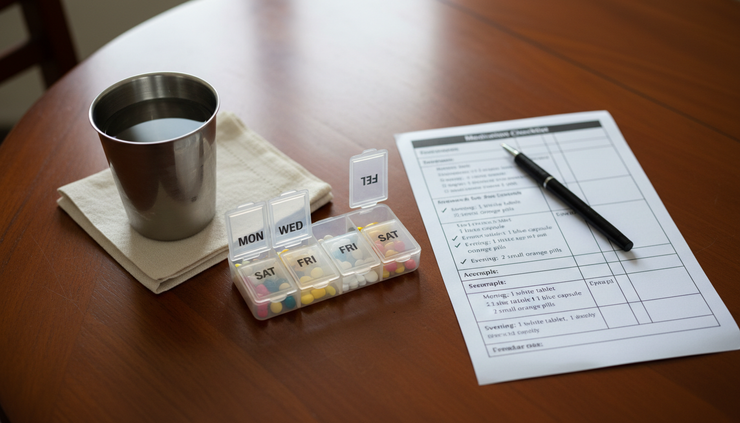
Use a weekly pill organiser if it is suitable
A pill organiser can work well for many tablets. Choose one with large compartments and clear day labels. Some organisers have morning, afternoon, evening, and night sections.
Fill it at the same time each week. Ideally, one family member fills it and another checks it, especially if the medicines are high risk.
Be careful with medicines that should stay in original packaging due to moisture, light, or special handling. If unsure, ask the pharmacist before moving tablets out of strips or bottles.
Keep the schedule written in plain language
A senior should not have to decode medical instructions every day. Use simple words.
Instead of:
`1-0-1 after meals`
Write:
“Take one tablet after breakfast and one tablet after dinner.”
Use large print. Tape the schedule near the usual medicine spot, such as the dining table, bedside shelf, or kitchen cabinet. Keep it away from children and pets.
Link medicines to daily habits
Habits are stronger than reminders. Attach medicine times to activities that already happen every day.
Good anchors include:
Morning tea
Breakfast
Lunch
Evening prayer
Dinner
Brushing teeth at night
The anchor must match the doctor’s instructions. Some medicines need food. Some need an empty stomach. Some should not be taken close to calcium, iron, or antacids. Confirm the timing before changing it.
Use alarms, but do not rely on them alone
Phone alarms, smart speakers, or reminder watches can help. But alarms fail when the phone is charging in another room, the senior silences it, or the sound becomes background noise.
A good reminder says exactly what to do:
“8:00 am, take BP tablet and thyroid tablet.”
For seniors who are comfortable with smartphones, a shared family reminder app can help. For others, a simple alarm clock may be better.
Track doses without making it feel like policing
A tick-mark chart can reduce uncertainty. Each time medicine is taken, the senior ticks the box.
Keep the chart simple:
Time | Monday | Tuesday | Wednesday | Thursday | Friday | Saturday | Sunday |
Morning | |||||||
Afternoon | |||||||
Night |
This helps everyone see patterns. It also avoids the common question, “Did I take it or not?”
Involve the pharmacist and doctor early
Families often wait until there is a serious mistake before asking for help. It is better to raise the issue when the first pattern appears.
A pharmacist can help with practical questions, such as:
Which tablets can go into an organiser
Which medicines look alike
Which should be taken with food
Which should be spaced apart
Whether side effects are common
How to store medicines during summer or travel
The doctor can review the medical side. Bring the medicine list, missed dose notes, and any home readings such as blood pressure or blood sugar records.
Ask whether missed medicines could explain any recent symptoms. Also ask whether symptoms could be causing the missed doses. For example, dizziness may make a senior avoid a blood pressure tablet. Night-time urination may make them skip an evening medicine. Nausea may make them avoid diabetes tablets.
This is also a good time to discuss swallowing trouble. Some seniors crush tablets to make them easier to take, but not all tablets are safe to crush. Extended-release, coated, or special-form medicines may become unsafe or less effective if broken. Always check first.
Watch for memory and thinking changes
Medicine mistakes can be an early sign that a senior needs more support. This does not always mean dementia. Infection, dehydration, poor sleep, grief, anxiety, low sodium, thyroid problems, vitamin deficiencies, and side effects can all affect memory or alertness.
Still, families should pay attention if missed medicines come with other changes:
Getting lost in familiar places
Repeating the same question many times
Missing bill payments
Burning food or leaving the gas on
Confusion about dates or time
Poor personal hygiene compared with usual habits
New suspicion, fear, or irritability
Trouble following conversations
Taking the wrong amount of medicine
If these signs appear, book a medical assessment. Early evaluation can find treatable causes and help the family plan support before a crisis.
For sudden confusion, do not wait for a routine appointment. Sudden changes can signal infection, stroke, low blood sugar, dehydration, or medicine side effects.
Share the responsibility carefully
A senior may still be able to manage medicines with light support. The goal is to preserve independence while reducing risk.
Start with the least intrusive support that works.
Level of support | What it looks like | When it may fit |
Gentle reminder | A call or message at medicine time | Occasional missed doses |
Weekly setup | A family member fills the organiser once a week | Confusing packaging or many medicines |
Daily check | Someone confirms morning and night doses | Repeated missed tablets |
Direct supervision | A caregiver hands over medicines | High-risk medicines or memory decline |
Medical reassessment | Doctor reviews safety and capacity | Wrong doses, double doses, or serious confusion |
Keep communication respectful. Say, “Let’s make this easier,” rather than “You can’t handle this.” If several family members are involved, choose one main person to coordinate. Too many instructions from different people can make the routine more confusing.
For seniors living alone, create a backup plan. A neighbour, relative, domestic helper, or caregiver may be able to check in. Medicine delivery reminders and refill calendars can also reduce gaps.
Make the home setup safer
Medication safety is partly about the environment. Small home changes can prevent big mistakes.
Keep medicines in one consistent place unless some need refrigeration. Avoid mixing old and new prescriptions in the same drawer. Remove expired medicines after checking with a pharmacist about safe disposal.
Store medicines away from children, pets, heat, and direct sunlight. In many Indian homes, summer heat can be intense, so avoid keeping medicines near windows, stoves, or inside parked vehicles.
Use large labels if the senior has poor eyesight. A thick marker can help identify morning and night medicines on outer packets, as long as it does not cover the printed name or expiry date.
Separate “daily medicines” from “as needed medicines.” Painkillers, sleeping tablets, acidity medicines, and cough syrups should not sit casually beside daily prescriptions if there is a risk of accidental use.
If the senior has diabetes, keep glucose tablets, sugar sachets, or another doctor-approved low sugar treatment nearby. Family members should know what low blood sugar looks like and when to seek help.

Know when missed medicines mean more help is needed
One missed dose after a busy day is different from repeated errors. Families should step in more firmly when there are signs of real risk.
Take action if:
Medicines are missed several times a week
The senior takes extra doses by mistake
Tablets from different days are mixed up
The senior cannot explain what has been taken
High-risk medicines are involved
Blood pressure or blood sugar readings become unstable
The senior hides missed doses out of embarrassment
There are falls, fainting spells, or sudden confusion
The senior lives alone and refuses all support
At this stage, the issue is not only adherence. It is safety.
The next step may be more frequent family check-ins, a paid caregiver, a nurse visit if available, or a review of living arrangements. Some families also speak with the doctor about whether the senior is safe to manage medicines independently.
These conversations can feel difficult. Still, waiting for a hospital admission, fall, or overdose makes the decision harder.
Keep dignity at the centre
Medication support works best when it honours the senior’s preferences. Ask what they find annoying, confusing, or tiring. Let them choose where the medicine box stays. Let them tick the chart if they can. Explain any changes before making them.
If the senior resists help, listen first. Resistance often has a reason.
They may worry about becoming dependent. They may dislike being watched. They may have had side effects that no one took seriously. They may not believe a medicine is necessary because the condition has no symptoms.
Blood pressure is a common example. A person may stop tablets because they do not feel unwell. The family can gently explain that some conditions need treatment even when symptoms are absent. The doctor can reinforce this in a neutral way.
Respect does not mean ignoring danger. It means solving the danger without shaming the person.
A simple plan for the next 48 hours
If the problem has just come to light, do not try to fix everything in one conversation. Use a short plan.
Check immediate safety
Identify what was missed and ask a doctor or pharmacist if the medicine is high risk.
Gather all medicines in one place
Include prescriptions, supplements, creams, inhalers, drops, and occasional medicines.
Make a clear list
Write the dose, time, purpose, and prescribing doctor.
Set up a temporary reminder system
Use phone alarms, a paper chart, or family calls until the routine is reviewed.
Book a medicine review
Take the list, packets, and notes about missed doses.
Agree on one support person
Choose who will check refills, update the list, and speak with the doctor when needed.
This small plan brings order quickly. It also reduces family arguments because everyone knows the next step.
The takeaway
When a senior starts missing medicines, treat it as information, not failure. Something in the routine, the body, the treatment plan, or the home setup is no longer working well enough.
Begin with safety. Speak without blame. Make one accurate medicine list. Ask the pharmacist and doctor to review the plan. Then build a routine that is simple, visible, and respectful.
The right support can protect health without taking away independence. Often, the best medicine system is not the most advanced one. It is the one the senior understands, trusts, and can follow every day.


Comments